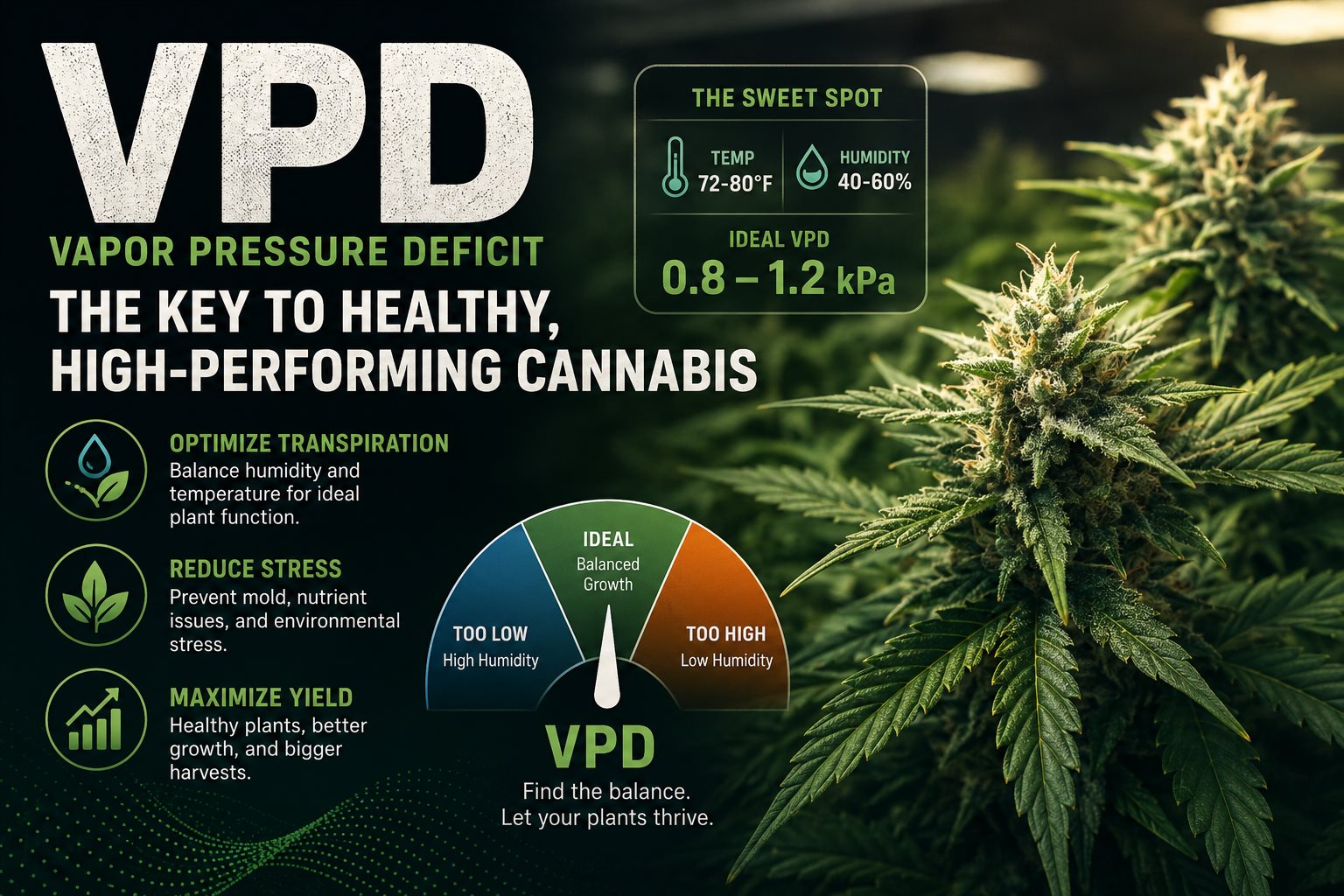
Understanding VPD: One of the Most Important Concepts in Cannabis Cultivation
When new growers start growing cannabis, they usually focus on lighting, nutrients, watering schedules, and genetics. While all of those things are important, there is another factor that often has a bigger impact on plant health than people realize: VPD.
VPD stands for Vapor Pressure Deficit. It sounds technical, but the idea is simple: VPD helps you understand how comfortable the air is for your cannabis plants.
What Is VPD?
In simple terms, VPD measures how much moisture the air can still absorb from your plant. Cannabis plants release water through tiny openings in their leaves called stomata. This process is called transpiration.
When the air is too dry, it pulls water out of the plant too quickly. When the air is too humid, moisture leaves the plant too slowly. When the air is balanced, the plant can move water and nutrients efficiently.
Why VPD Matters for Cannabis
Transpiration helps cannabis plants move water and nutrients from the roots to the leaves. It also helps regulate plant temperature and supports photosynthesis.
When VPD is in a good range, your plants can grow faster, handle nutrients better, and stay healthier. When VPD is too high or too low, plants can become stressed even if your watering and feeding are correct.
Think of a Wet Sponge
Imagine your cannabis plant is like a wet sponge. If you put that sponge in a very dry room, water evaporates quickly. If you put it in a humid bathroom after a shower, water evaporates slowly.
Your plant works the same way. The surrounding air controls how quickly moisture leaves the leaves. VPD gives growers a way to understand that drying pressure.
Temperature and Humidity Work Together
A common mistake is looking at humidity by itself. Temperature and humidity are connected. Warm air can hold more moisture than cool air, so 60% humidity at 70°F is not the same as 60% humidity at 85°F.
This is why VPD is useful. It combines temperature and humidity into a better picture of what your cannabis plant is actually experiencing.
What Happens When VPD Is Too Low?
Low VPD usually means the air is too humid. The air is already holding a lot of moisture, so it does not easily accept more water from the plant.
- Slower growth
- Weak transpiration
- Reduced nutrient movement
- Higher risk of mold
- Higher risk of powdery mildew
What Happens When VPD Is Too High?
High VPD usually means the air is too dry. The air pulls moisture from the leaves too aggressively. This can make the plant work harder than it should.
- Leaf curling
- Wilting
- Dry or crispy leaf edges
- Excessive water use
- Nutrient uptake problems
- General plant stress
VPD by Cannabis Growth Stage
Seedlings and Clones
Young plants prefer higher humidity because their root systems are still developing. A lower VPD helps them avoid drying out too quickly.
Typical range: 72°F–78°F with 65%–75% humidity.
Vegetative Growth
During veg, plants can handle more transpiration. This supports strong leaf growth, root development, and nutrient movement.
Typical range: 75°F–82°F with 55%–70% humidity.
Flowering
Flowering plants usually benefit from lower humidity. This helps reduce mold risk while still keeping transpiration active.
Typical range: 70°F–80°F with 40%–55% humidity.
Late Flower
Dense buds can trap moisture, so many growers lower humidity even more toward the end of flower.
Typical range: 68°F–78°F with 35%–50% humidity.
The Geeky Part: How VPD Is Calculated
For growers who like the technical side, VPD is calculated using air temperature, relative humidity, and sometimes leaf temperature. The calculation compares how much moisture the air could hold against how much moisture is currently in the air.
The difference between those two values is the vapor pressure deficit. A bigger deficit means stronger drying pressure. A smaller deficit means weaker drying pressure.
Commercial grow rooms often use sensors, HVAC systems, humidifiers, dehumidifiers, and controllers to keep VPD in the ideal range throughout the day.
Why Leaf Temperature Matters
Most beginner VPD charts assume leaf temperature is close to air temperature. In reality, leaves are often slightly cooler than the air around them.
More advanced growers may use an infrared temperature gun to measure leaf temperature and calculate VPD more accurately. For most home growers, using air temperature is still good enough to make useful improvements.
How to Improve VPD in Your Grow Room
If VPD Is Too Low
- Lower humidity
- Increase airflow
- Use a dehumidifier
- Increase exhaust fan speed
If VPD Is Too High
- Increase humidity
- Reduce excessive heat
- Use a humidifier
- Improve environmental stability
Common VPD Mistakes
Chasing Perfect Numbers
You do not need to hit a perfect VPD number every minute of the day. Plants prefer stability. Being close and consistent is usually better than constantly changing your environment.
Ignoring the Plant
VPD charts are helpful, but your plants still matter most. If your plants look healthy, are praying toward the light, and are growing well, you may not need to make major changes.
Only Watching Humidity
Humidity alone does not tell the full story. Temperature and humidity work together, which is why VPD is a better environmental guide.
Do You Need VPD to Grow Good Cannabis?
No. Growers have successfully grown cannabis for many years without calculating VPD. However, understanding VPD can help explain problems that are otherwise confusing.
If your watering is correct, your nutrients are correct, and your lighting is good, but your plants still seem stressed, your environment may be the missing piece.
Final Thoughts
VPD may sound complicated at first, but the main idea is simple: your cannabis plant is constantly moving water through its system, and the air around the plant controls how easily that happens.
When temperature and humidity are balanced, plants can transpire properly, absorb nutrients efficiently, and grow with less stress.
You do not need to become a scientist to benefit from VPD. Start by watching your temperature, humidity, and plant behavior. Small improvements in environmental stability can make a big difference from seedling to harvest.
Continue Learning
New to growing cannabis? Explore more step-by-step guides covering germination, vegetative growth, flowering, harvesting, drying, curing, nutrients, lighting, and common plant problems.
Start Tracking Your Grow the Smart Way
Join growers using PLNTRK to track plants, log data, monitor VPD, and improve yields with powerful tools designed for modern cannabis cultivation.
Gallery