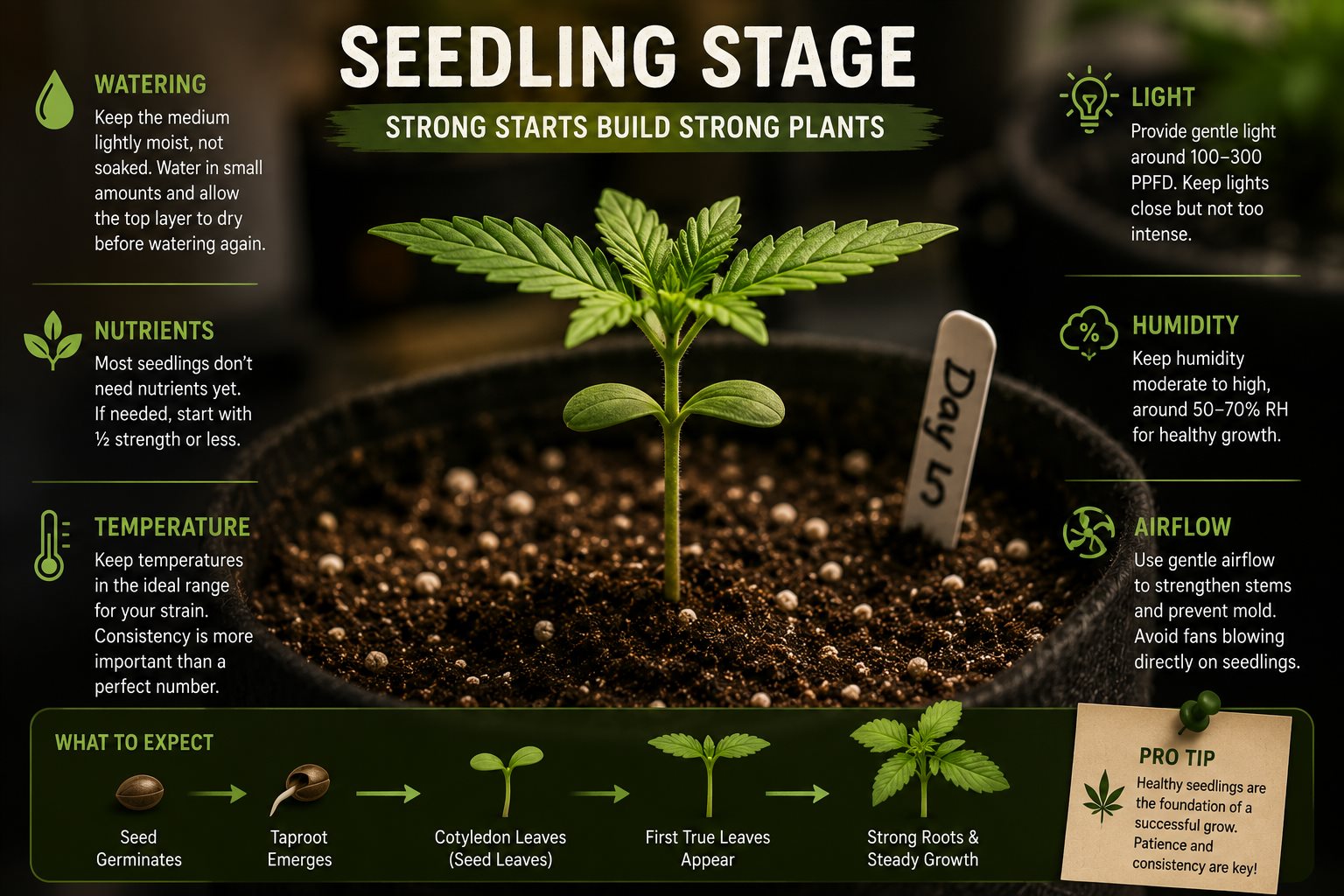
Stages of Growth: The Cannabis Seedling Stage
After germination, the cannabis plant enters the seedling stage. This is one of the shortest phases of the plant's life cycle, typically lasting about one to two weeks.
During this stage, the young plant begins establishing its first roots, developing its initial sets of leaves, and adjusting to the soil or other growing medium. Although the seedling stage may appear quiet compared with later growth, the conditions provided during these first days can have a major effect on the health of the plant.
What Happens During the Seedling Stage?
A cannabis seedling begins with its first rounded leaves, known as cotyledons. These leaves provide stored energy to the young plant while its root system begins developing.
The plant will soon produce its first sets of true leaves. As the seedling becomes more established, each new set of leaves generally develops more of the familiar serrated cannabis-leaf shape.
At this stage, growth above the soil may appear slow because much of the plant's energy is being directed toward root development.
Watering Cannabis Seedlings
Seedlings have small and delicate root systems, so they do not need large amounts of water. One of the most common mistakes during this stage is overwatering.
The growing medium should remain lightly moist, but it should not be saturated. Excess water can reduce oxygen around the roots and increase the risk of root problems, fungus, and damping off.
Helpful watering practices include:
- Use small amounts of water at a time.
- Water near the seedling rather than soaking the entire container.
- Allow the upper surface of the medium to begin drying between waterings.
- Make sure the container has adequate drainage.
- Avoid leaving the seedling in standing water.
Watering frequency will depend on the container size, growing medium, temperature, humidity, and airflow.
Feeding and Nutrients
Many seedlings do not need additional nutrients immediately. Their cotyledons provide early energy, and many commercial potting soils already contain enough nutrition to support the first stage of growth.
Adding strong nutrients too early can burn the young roots and leaves. When using a nutrient-rich soil, it is often better to begin with plain, properly prepared water.
If your cultivation system or feeding schedule requires nutrients during the seedling stage, begin with a very mild concentration. Monitor the seedling closely before increasing the amount.
Signs of excessive nutrients may include:
- Brown or burned leaf tips
- Very dark green leaves
- Leaves curling downward
- Slowed or distorted growth
Finding the Right Temperature
Different cannabis strains may prefer slightly different temperature ranges. When multiple strains are grown in the same room, the goal is to find a stable temperature that falls within the acceptable range for all of them.
For example, one strain may perform best in warmer conditions while another may prefer a cooler environment. Comparing their recommended ranges can help identify a shared temperature that keeps the entire grow comfortable.
Consistency is often more important than achieving one perfect number. Sudden temperature swings can stress young plants and slow their development.
Managing Humidity
Seedlings generally benefit from moderate-to-high relative humidity because their root systems are still developing and they lose moisture through their leaves.
The ideal humidity level may vary between strains and grow environments. When growing several strains together, select a level that falls within the acceptable range for each plant.
Humidity should be monitored with a reliable hygrometer placed near the plant canopy. Avoid allowing the environment to become excessively wet or stagnant, since high humidity combined with poor airflow can encourage mold and fungal growth.
Seedling Light Levels
Seedlings need light, but young plants cannot tolerate the same intensity used during late vegetative growth or flowering.
A general seedling range is approximately 100 to 300 micromoles per square meter per second on a PPFD meter.
Light that is too intense can cause bleaching, curling, or dry leaves. Light that is too weak may cause the seedling to stretch as it grows toward the fixture.
Signs that the light may be too weak include:
- A long, thin stem
- Large spacing between leaf sets
- The plant leaning toward the light
- Difficulty supporting its own weight
Signs that the light may be too strong include:
- Upward-curling leaf edges
- Pale or bleached leaves
- Dry spots
- Slowed growth
Airflow During the Seedling Stage
Seedlings benefit from gentle air movement. A light breeze helps reduce stagnant moisture and encourages the stem to become stronger.
Do not point a strong fan directly at a young seedling. The airflow should only cause the leaves and stem to move slightly.
Too much direct airflow can dry the plant, damage tender leaves, or cause the stem to bend excessively.
Common Seedling Problems
| Problem | Possible Cause | What to Check |
|---|---|---|
| Stretching | Insufficient light | Light intensity and fixture distance |
| Drooping leaves | Overwatering or underwatering | Moisture level and drainage |
| Burned leaf tips | Excess nutrients | Soil strength and feeding concentration |
| Pale leaves | Lighting, pH, or nutrient issue | Light intensity, water, and root conditions |
| Weak stem | Low light or insufficient airflow | Fixture position and gentle circulation |
| Stem collapsing near soil | Damping off or excessive moisture | Humidity, airflow, sanitation, and watering |
When Does the Seedling Stage End?
The seedling stage begins transitioning into vegetative growth once the plant has developed several sets of true leaves and a more established root system.
At this point, the plant should begin growing more quickly and may be ready for stronger lighting, a larger container, and a gradual increase in nutrients.
Do not rush the transition. Allow the plant to demonstrate healthy, consistent growth before making significant changes to its environment or feeding schedule.
Keep the Seedling Stage Simple
Young cannabis plants do not need an aggressive feeding schedule or complicated equipment. They need stable conditions, gentle light, careful watering, and time to establish their roots.
Monitor the environment closely, but avoid making constant adjustments unless the plant is showing a clear problem. Consistency during the seedling stage gives the plant a strong foundation for the more active vegetative growth ahead.
Continue Learning
New to growing cannabis? Explore more step-by-step guides covering germination, vegetative growth, flowering, harvesting, drying, curing, nutrients, lighting, and common plant problems.
Start Tracking Your Grow the Smart Way
Join growers using PLNTRK to track plants, log data, monitor VPD, and improve yields with powerful tools designed for modern cannabis cultivation.
Gallery