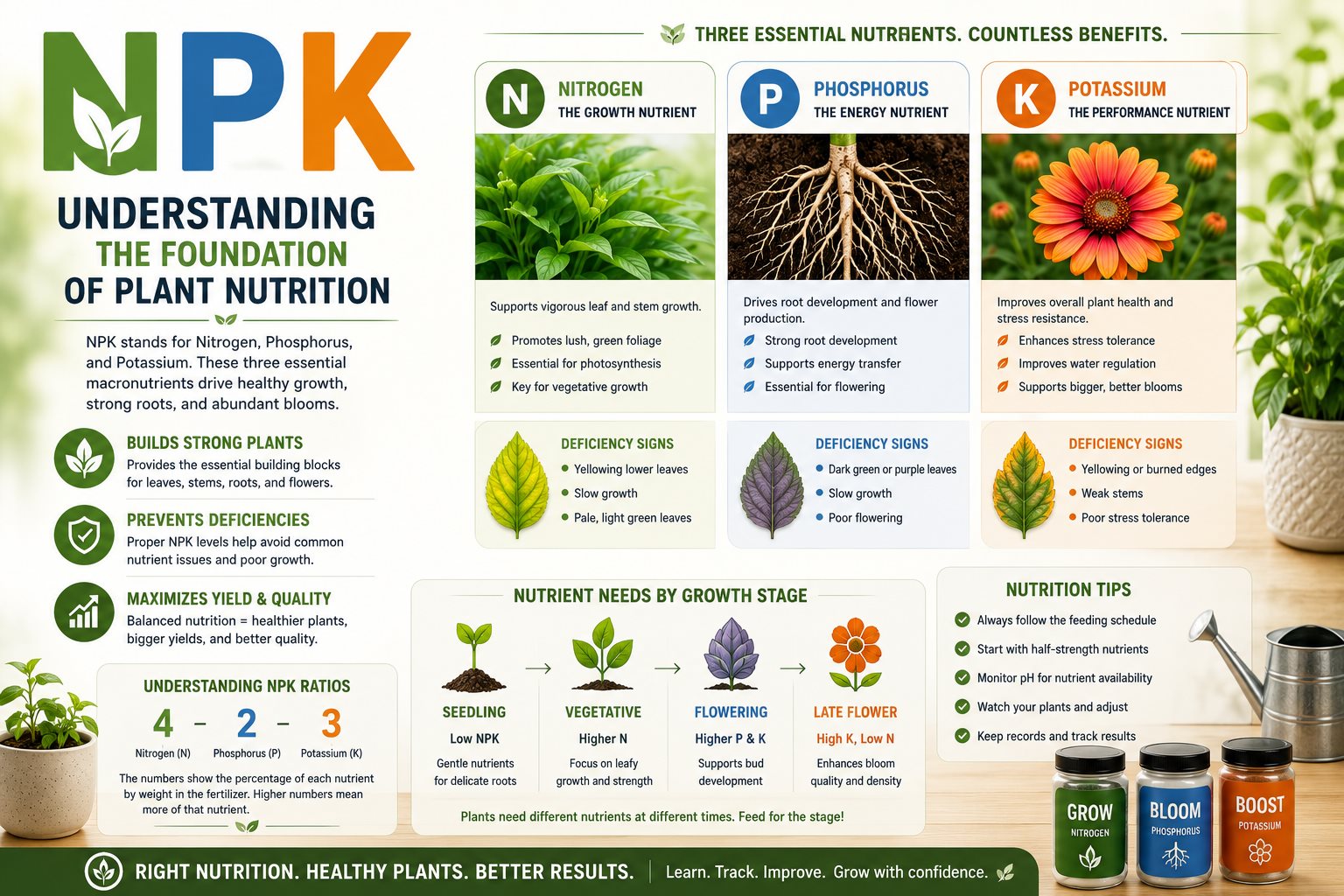
If you've ever looked at a bottle of cannabis nutrients and wondered what the numbers on the label mean, you're not alone. Nearly every nutrient product contains three numbers, such as 3-1-2, 4-4-4, or 1-5-7.
These numbers represent one of the most important concepts in plant nutrition: NPK.
Understanding NPK helps growers make better decisions about feeding schedules, nutrient selection, and diagnosing plant health issues. While nutrient companies often advertise advanced formulas and special ingredients, nearly all cannabis nutrition starts with three primary nutrients: Nitrogen, Phosphorus, and Potassium.
In this guide, we'll explain what NPK means, how each nutrient affects cannabis growth, and how nutrient needs change throughout the plant's lifecycle.
What Does NPK Stand For?
NPK stands for:
- N = Nitrogen
- P = Phosphorus
- K = Potassium
These are known as the three primary macronutrients because cannabis plants use them in relatively large quantities throughout their lives.
Think of these nutrients as the major building blocks that fuel growth, development, and flower production.
Understanding Nutrient Labels
Nutrient manufacturers display NPK values using three numbers.
Example: 4-2-3
- 4 = Nitrogen
- 2 = Phosphorus
- 3 = Potassium
These numbers represent the relative percentages of each nutrient in the product.
The larger the number, the more of that nutrient is present relative to the others.
Nitrogen (N): The Growth Nutrient
Nitrogen is often considered the engine behind vegetative growth.
It plays a major role in:
- Leaf production
- Stem development
- Chlorophyll creation
- Photosynthesis
- Overall plant vigor
Cannabis plants require significant amounts of nitrogen during the vegetative stage when they are actively producing leaves and branches.
A healthy supply of nitrogen helps plants maintain a rich green color and rapid growth.
Signs of Nitrogen Deficiency
When cannabis plants don't receive enough nitrogen, older leaves are usually affected first.
- Yellowing lower leaves
- Slow growth
- Pale green foliage
- Reduced vigor
- Premature leaf drop
Nitrogen is mobile within the plant, meaning the plant can move it from older leaves to newer growth when supplies become limited.
Signs of Too Much Nitrogen
More nutrients do not always mean better growth.
Excessive nitrogen can cause:
- Very dark green leaves
- Leaf clawing
- Weak stems
- Delayed flowering
- Reduced bud development
Many beginner growers accidentally overfeed nitrogen because they assume bigger doses will produce faster growth.
Phosphorus (P): The Energy Nutrient
Phosphorus plays a critical role in energy transfer throughout the plant.
It helps support:
- Root development
- Flower production
- Energy storage
- Cell division
- Overall plant metabolism
While phosphorus is important throughout the entire grow, it becomes especially important during flowering.
Signs of Phosphorus Deficiency
- Slow growth
- Dark green leaves
- Purple stems or petioles
- Small flowers
- Reduced root development
Phosphorus deficiencies are often influenced by pH problems rather than an actual lack of phosphorus in the growing medium.
Potassium (K): The Performance Nutrient
Potassium is responsible for regulating many important plant functions.
It contributes to:
- Water movement
- Stress resistance
- Disease resistance
- Bud development
- Nutrient transport
Potassium helps cannabis plants stay healthy and productive, particularly during flowering.
Signs of Potassium Deficiency
- Burned leaf edges
- Yellowing leaf margins
- Weak growth
- Poor flower development
- Reduced stress tolerance
Potassium deficiencies often appear around the edges of leaves before spreading inward.
Cannabis Nutrient Needs Throughout Growth
Cannabis does not require the same nutrient ratios throughout its entire life.
As the plant develops, its priorities change.
Seedling Stage
Young seedlings require very little nutrition.
Overfeeding seedlings is one of the most common mistakes beginners make.
At this stage, root development and gentle growth are more important than aggressive feeding.
Vegetative Growth
During vegetative growth, cannabis plants prioritize stems, branches, and leaves.
This means nitrogen becomes the dominant nutrient.
Veg nutrients typically contain higher nitrogen levels than bloom nutrients.
Flowering Stage
Once flowering begins, nutrient priorities shift dramatically.
Plants begin focusing less on producing leaves and more on producing flowers.
Growers often transition to bloom nutrients that contain:
- Lower nitrogen
- Higher phosphorus
- Higher potassium
Why Nutrient Ratios Matter
Imagine feeding a bodybuilder only carbohydrates and no protein. They may have plenty of calories, but they won't have the proper nutrition for muscle growth.
Plants work similarly.
The right nutrient at the right stage often matters more than simply feeding more nutrients.
NPK Isn't Everything
While NPK is extremely important, cannabis plants also require secondary nutrients and micronutrients.
These include:
- Calcium
- Magnesium
- Sulfur
- Iron
- Zinc
- Manganese
- Copper
- Boron
These nutrients are required in smaller quantities but remain essential for healthy growth.
Organic vs Synthetic Nutrients
Both organic and synthetic nutrient programs ultimately provide plants with the same essential nutrients.
The primary difference is how those nutrients become available to the plant.
Organic systems rely heavily on microbial activity and natural breakdown processes, while synthetic nutrients provide nutrients in forms that are immediately available.
Common Nutrient Mistakes
- Feeding too much too soon
- Ignoring pH
- Changing nutrient programs too frequently
- Assuming more nutrients equals bigger yields
- Not following feeding schedules
- Ignoring plant feedback
Healthy cannabis plants often need less food than new growers expect.
Tracking Nutrient Applications
One of the best ways to improve your growing skills is to record every nutrient application.
Tracking:
- Feeding dates
- Nutrient brands
- NPK values
- Dosage amounts
- pH readings
- Plant response
can help identify successful feeding schedules and prevent repeating mistakes in future grows.
Final Thoughts
Understanding NPK is one of the most valuable skills a cannabis grower can develop. Nitrogen, phosphorus, and potassium are the foundation of plant nutrition and directly influence growth, health, and flower production.
By learning what each nutrient does and how nutrient needs change throughout the plant's lifecycle, you'll be better equipped to diagnose issues, choose appropriate nutrient products, and maximize plant performance.
Remember that successful feeding is not about using the most nutrients. It's about providing the right nutrients at the right time while maintaining proper pH and environmental conditions.
Continue Learning
New to growing cannabis? Explore more step-by-step guides covering germination, vegetative growth, flowering, harvesting, drying, curing, nutrients, lighting, and common plant problems.
Start Tracking Your Grow the Smart Way
Join growers using PLNTRK to track plants, log data, monitor VPD, and improve yields with powerful tools designed for modern cannabis cultivation.
Gallery