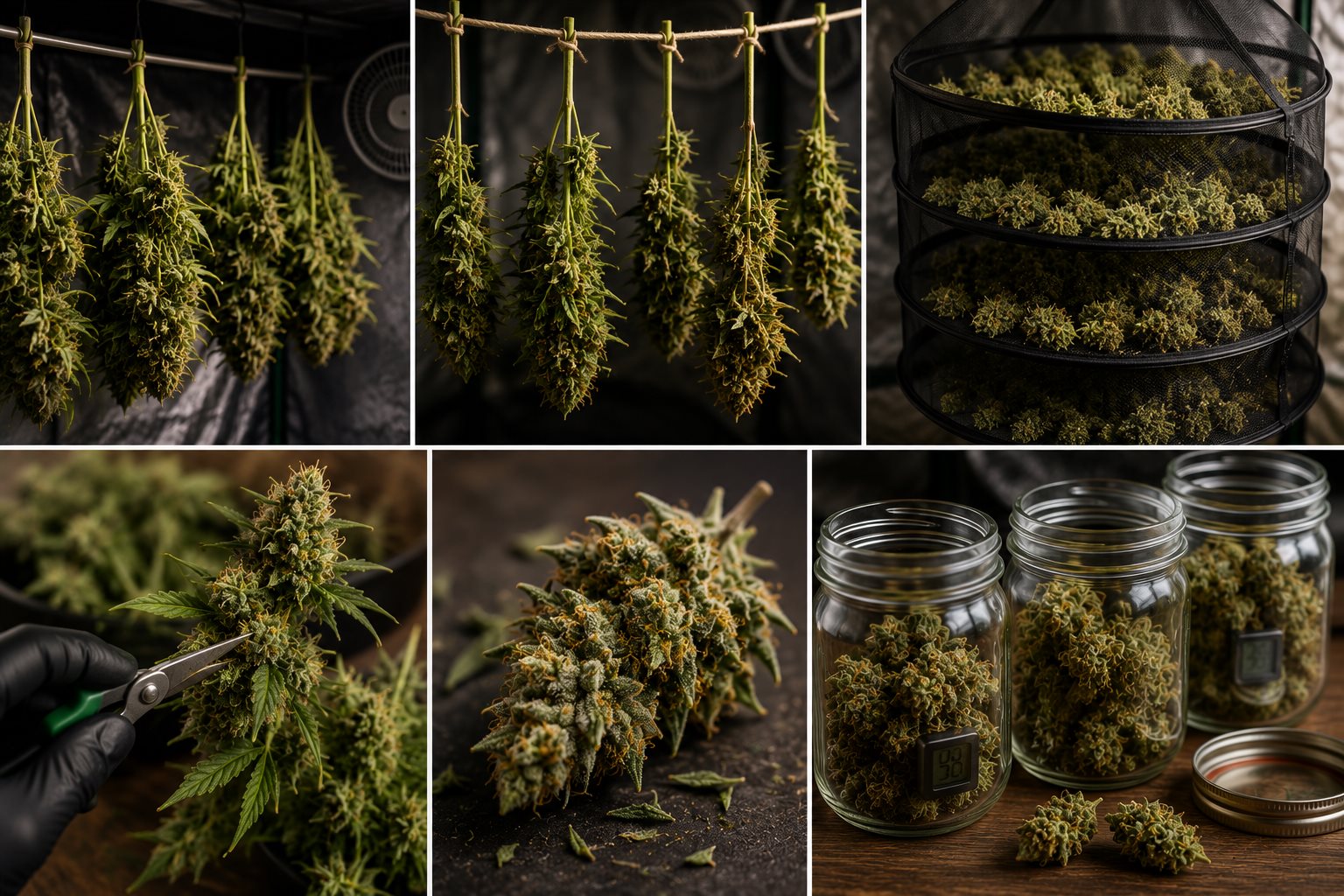
Stages of Growth: Drying & Curing Cannabis
Harvest day is exciting, but your work isn't finished once the plants are cut down. Proper drying and curing are critical steps that preserve potency, terpene profile, aroma, flavor, and overall smoking experience.
Even perfectly grown cannabis can lose much of its quality if it dries too quickly, too slowly, or is cured improperly. Taking your time during this final stage can make the difference between average flower and premium-quality buds.
The 60/60 Rule
Many experienced growers follow a simple guideline often referred to as the 60/60 Rule.
The goal is to maintain:
- Approximately 60°F (15-16°C)
- Approximately 60% Relative Humidity
- For roughly 6 to 14 days
Slowing the drying process helps preserve valuable terpenes while reducing the risk of harsh smoke and hay-like aromas.
Rather than relying solely on the calendar, monitor the plant itself. Small branches should begin to snap instead of bending before curing begins.
Method 1: Hanging the Entire Plant
Hanging the entire harvested plant upside down is one of the most common drying methods.
Before hanging, many growers remove only the large fan leaves while leaving the remaining branches and buds attached to the main stem.
Advantages include:
- Simple setup
- Minimal trimming before drying
- Slower, more controlled moisture loss
- Good option for preserving terpene content
This method works well when adequate drying space is available and environmental conditions can be controlled.
Method 2: Hanging Individual Branches
Instead of hanging the entire plant, growers can separate individual branches and hang each one independently.
Although this requires more preparation immediately after harvest, it often provides better airflow around each branch and may produce a slightly more even drying process.
Benefits include:
- Improved airflow
- Better spacing between flowers
- Easier trimming after drying
- Flexible use of drying space
Drying should still remain gradual. Faster drying is not necessarily better if it reduces overall flower quality.
Method 3: Drying Rack (Wet Trim)
Another option is to perform a wet trim immediately after harvest and place the buds on a mesh drying rack.
This method is sometimes referred to as "bucking", since the buds are removed from the branches before drying.
When using drying racks:
- Space buds apart evenly.
- Do not allow buds to touch each other.
- Rotate trays if necessary for even drying.
- Maintain consistent airflow without blowing directly on the flowers.
Proper spacing helps prevent moisture from becoming trapped between buds, reducing the risk of mold.
How Do You Know It's Ready?
A common way to evaluate drying progress is by checking smaller stems rather than the flowers themselves.
If the branch bends without breaking, additional drying time is usually needed. When smaller stems begin snapping instead of bending, the flowers are often ready to move into the curing stage.
Buds should not become brittle or crumble apart. Drying too far before curing can permanently reduce quality and aroma.
Why Curing Matters
Drying removes most of the moisture, but curing finishes the job by slowly removing remaining internal moisture while allowing the flower to mature.
During curing:
- Chlorophyll continues breaking down.
- Flavor improves.
- Aroma becomes more pronounced.
- Smoke becomes smoother.
- Moisture equalizes throughout each flower.
Some growers cure for only a few weeks, while others continue curing for several months before enjoying the finished product.
Mason Jar Curing
Mason jars remain one of the most widely used curing methods.
Many growers place a small digital hygrometer inside each jar to monitor internal humidity.
During the first several weeks, jars are periodically opened in a process commonly called burping.
Burping helps:
- Release excess moisture.
- Replace stale air with fresh air.
- Prevent mold growth.
- Maintain ideal humidity levels.
A relative humidity of approximately 60-62% is commonly considered a good long-term storage target.
Using Grove Bags
Grove Bags have become increasingly popular because they are designed to simplify the curing process.
When flowers have been dried properly before storage, many growers find that Grove Bags require little or no burping while helping maintain stable humidity.
However, flowers that are placed into storage while still overly wet can retain too much moisture regardless of the storage method.
Proper drying should always come before curing. No storage container can completely correct flowers that were not dried appropriately.
Comparing Drying & Curing Methods
| Method | Best For | Main Advantage | Main Consideration |
|---|---|---|---|
| Whole Plant Hanging | Slow drying | Simple and preserves moisture | Requires more drying space |
| Individual Branches | Balanced drying | Better airflow | More preparation time |
| Drying Rack | Wet trimming | Efficient space usage | Requires careful spacing |
| Mason Jars | Traditional curing | Excellent humidity control | Requires regular burping |
| Grove Bags | Simplified curing | Less maintenance | Requires properly dried flower first |
Final Thoughts
Drying and curing are often overlooked, but they play an enormous role in determining the final quality of your cannabis. Aroma, flavor, smoothness, potency, and shelf life are all influenced by how carefully you manage these final weeks.
Be patient, maintain stable environmental conditions, and resist the temptation to rush the process. A well-executed dry and cure allows the flowers to reach their full potential and rewards all of the hard work invested throughout the grow cycle.
Continue Learning
New to growing cannabis? Explore more step-by-step guides covering germination, vegetative growth, flowering, harvesting, drying, curing, nutrients, lighting, and common plant problems.
Start Tracking Your Grow the Smart Way
Join growers using PLNTRK to track plants, log data, monitor VPD, and improve yields with powerful tools designed for modern cannabis cultivation.
Gallery