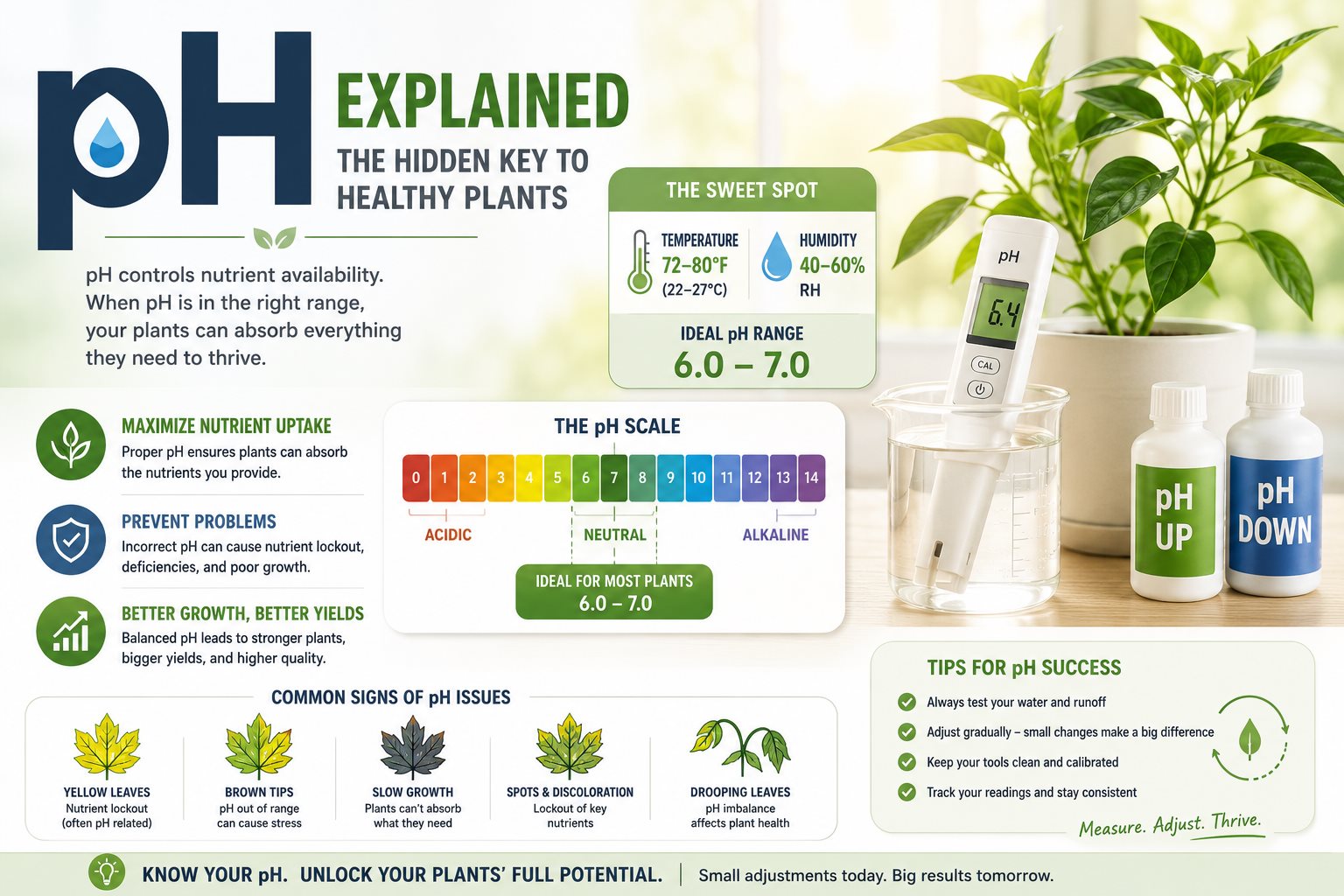
If there is one topic that confuses new cannabis growers more than almost any other, it is pH. Many growers spend hundreds or even thousands of dollars on lights, nutrients, tents, and environmental equipment, only to discover that their plants are struggling because of a simple pH problem.
The good news is that pH is much easier to understand than most people think. Once you understand the basics, you'll be able to diagnose problems faster, grow healthier plants, and avoid many of the most common issues that frustrate growers.
In this guide, we'll explain what pH is, why it matters, how it affects nutrient uptake, and how to maintain the proper pH throughout your grow.
What Is pH?
pH is a measurement of how acidic or alkaline a liquid or growing medium is. The pH scale ranges from 0 to 14.
- pH 7.0 = Neutral
- Below 7.0 = Acidic
- Above 7.0 = Alkaline (Basic)
Cannabis plants can only absorb nutrients efficiently within certain pH ranges. If the pH moves too far outside those ranges, nutrients become unavailable to the plant, even if those nutrients are present in the soil or reservoir.
Why pH Matters So Much
Imagine placing a delicious meal in front of someone and then locking their mouth shut. The food is available, but they cannot access it.
The same thing happens with cannabis plants when pH is incorrect. Nutrients may be present in abundance, but the plant cannot absorb them effectively.
This condition is commonly called nutrient lockout.
Many growers mistakenly think they need more nutrients when the real problem is simply incorrect pH.
Understanding Nutrient Lockout
Different nutrients become available at different pH levels. When pH drifts outside the ideal range, certain nutrients become difficult or impossible for the plant to absorb.
This can create symptoms that look exactly like nutrient deficiencies:
- Yellow leaves
- Brown leaf tips
- Purple stems
- Slow growth
- Leaf spotting
- Poor flowering
Adding more nutrients often makes the situation worse because the plant still cannot absorb them properly.
Ideal pH for Soil Grows
Soil acts as a natural buffer, making it somewhat forgiving for beginners.
Most cannabis plants grown in soil perform best between:
Recommended Soil pH
6.0 to 7.0
Many growers aim for approximately 6.3 to 6.8 during most of the grow cycle.
Ideal pH for Coco Coir
Coco behaves differently than soil and is closer to hydroponics in how nutrients are delivered.
Recommended Coco pH
5.8 to 6.2
Many coco growers target 5.8 to 6.0 for optimal nutrient availability.
Ideal pH for Hydroponics
Hydroponic systems require tighter environmental control because there is little natural buffering.
Recommended Hydro pH
5.5 to 6.5
Most hydro growers operate between 5.8 and 6.2.
Common Signs of pH Problems
Yellow Leaves
One of the most common indicators of pH-related nutrient lockout.
Brown Spots
Often associated with calcium or magnesium uptake issues.
Slow Growth
Plants may appear healthy but simply stop growing vigorously.
Leaf Tip Burn
Can occur when nutrients accumulate because the plant is unable to absorb them correctly.
How to Measure pH
Modern growers have several options:
- Digital pH pens
- Liquid test kits
- pH test strips
- Continuous monitoring systems
Digital pH pens are generally the easiest and most accurate option for home growers.
Calibrating Your pH Meter
Even the best pH meter becomes inaccurate over time.
Calibration solutions help ensure your readings remain accurate. Most manufacturers recommend calibration every few weeks, especially during active grows.
How to Raise or Lower pH
Growers typically use products known as pH Up and pH Down.
- pH Up increases pH
- pH Down lowers pH
Always make adjustments gradually. A small amount can significantly change the final reading.
The Importance of Runoff Testing
Measuring the water going into your plant is important, but measuring runoff can reveal what is happening inside the root zone.
Large differences between input and runoff pH may indicate salt buildup, nutrient imbalances, or developing root zone issues.
Should You Check pH Every Watering?
Most growers should check pH regularly, especially when mixing nutrients.
Over time, you'll become familiar with your water source and nutrient schedule, but regular testing helps catch problems before they become serious.
Common Beginner Mistakes
- Never checking pH
- Assuming nutrients are the problem
- Using uncalibrated pH pens
- Making large adjustments too quickly
- Ignoring runoff measurements
Final Thoughts
pH may not be the most exciting part of cannabis cultivation, but it is one of the most important. Many issues that appear to be nutrient deficiencies, watering problems, or environmental stress are actually caused by improper pH.
By learning how to monitor and maintain pH, you'll dramatically improve nutrient uptake, plant health, growth rates, and ultimately your harvest.
Before buying more nutrients, changing lights, or chasing complex solutions, always check your pH first. It is often the hidden factor standing between a struggling plant and a thriving one.
Continue Learning
New to growing cannabis? Explore more step-by-step guides covering germination, vegetative growth, flowering, harvesting, drying, curing, nutrients, lighting, and common plant problems.
Start Tracking Your Grow the Smart Way
Join growers using PLNTRK to track plants, log data, monitor VPD, and improve yields with powerful tools designed for modern cannabis cultivation.
Gallery